Projects
Language models for quantum chemistry
In my current research, I develop language models for quantum chemistry. The goal is to teach models to find low-energy states of large molecules, which underpin important chemical properties such as stability and reactivity. Accurate classical calculations become prohibitively expensive even for moderately sized molecules, making AI a promising route to larger systems.
Our models speak a custom language of quantum operators, which they use to prepare low-energy molecular states conditioned on information about the molecule’s structure and Hamiltonian. We generate training data using established classical methods on tractable problems and small active spaces, and make architectural and design choices to leverage this information as effectively as possible when generalizing to larger systems. We additionally fine-tune the models with reinforcement learning, using the energy of each model-prepared state as a direct performance signal and reducing reliance on classically generated training data.
In our first paper in this direction, we applied these methods to find the ground state of different conformations of imipramine, a relatively large and flexible molecule used as an antidepressant.
AI-optimized state preparation
A major challenge for near-term quantum computing is preparing useful quantum states with as few gates as possible. We reformulated the preparation of an important class of states for quantum error correction as a graph optimization problem. We developed an \textit{AlphaZero}-style framework to integrate Monte Carlo tree search with reinforcement learning, which enabled us to find solutions up to 2.5 times better than state-of-the-art for error correcting codes up to 144 qubits. We demonstrated that the planning enabled by tree search was also crucial, and enabled this approach to outperform strong alternatives including beam search and reinforcement learning alone.
Data inference with jets
A major focus of my research is developing techniques to use large and complex data most directly to access the properties of the plasma. My research focuses on using jets - sprays of high-energy particles produced inside the quark-gluon plasma. However, jets themselves are very complicated objects, so my research focuses on identifying special types of analysis techniques or physical processes where we can access new information using data.
Jets with two charm quarks
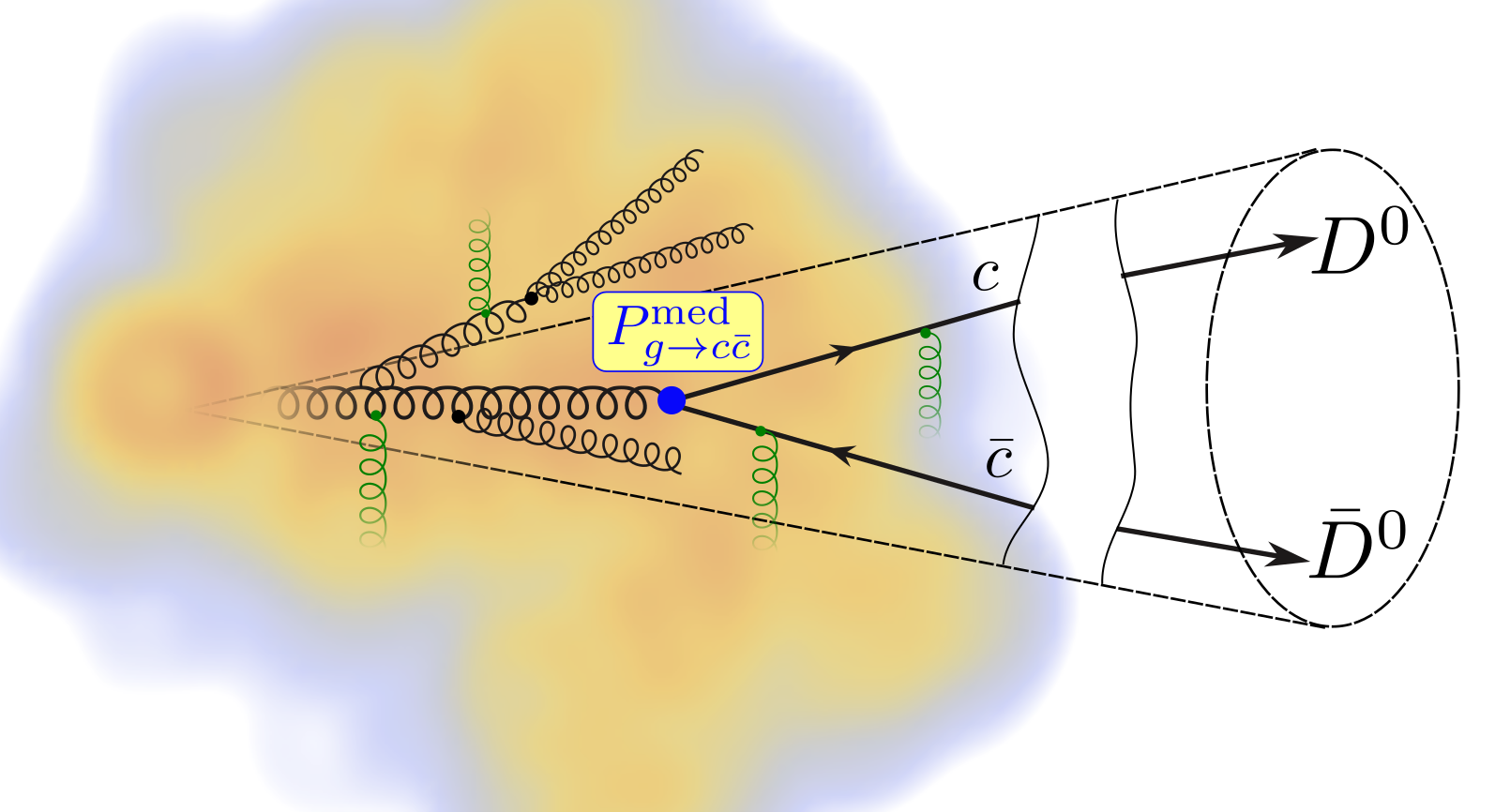 Jets containing two charm quarks provide a unique opportunity to connect theory to experiment, by making it possible to directly access the underlying gluon splitting to charm quarks. These processes allow us to access physics that cannot be accessed in other processes, including medium-enhanced charm production we demonstrated in arXiv:2209.13600, based on theoretical developments in arXiv:2203.11241.
Ongoing projects
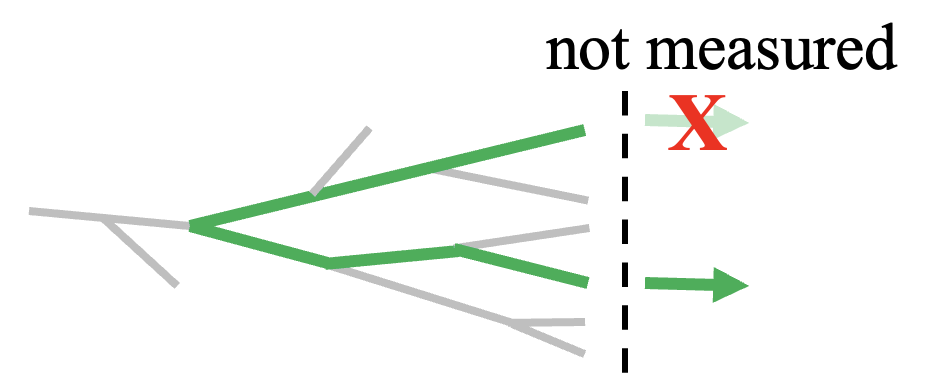 Machine learning - I am developing techniques to use neural networks and boosted decision trees to identify jets containing two charm quarks in the case that only one of the charm quarks is measured.
Flavor tagging with substructure - I am using jet substructure to identify the gluon splitting to charm quarks inside a jet with two charm, and to identify the types of other splittings within this type of jet. Code for this analysis is available on github.
Disentangling quark and gluon jets
Jets come in two types - they can be initiated either by quarks or gluons - which give them different properties and influence their interaction with the quark-gluon plasma. Separating measurements into quark and gluon jets can be viewed as a topic modelling problem. Two unlabelled mixtures of two underlying categories, in this case quark and gluon jets, can be separated into measurements on each category. I demonstrated this technique for separating quark and gluon jet measurements in heavy-ion collisions. We demonstrated the technique for the first time in arXiv:2008.08596 and showed how it can be used for a variety of observables in arXiv:2204.00641. The code is available on github.
Microscopic dynamics and emergent phenomena in complex systems
A significant part of my research focuses on non-equilibrium quantum systems and equilibration in the quark-gluon plasma. One part of this direction is that I develop simulations based on the microscopic interactions of individual particles to understand the emergent macroscopic dynamics. I have also developed a strategy to explain emergent simplicity in the dynamics of complex non-equilibrium systems. You can download Mathematica code to solve the kinetic equation to the onset of prescaling here.